
 rohilkhandcancerinstitutebly@gmail.com



Brain tumor – Symptoms and causes


Brain tumor – Symptoms and causes
A cell growth inside or close to the brain is called a brain tumour. Brain tissue can develop brain tumours. Brain tumours may also occur in close proximity to brain tissue. Neural pathways, the pituitary, pineal, and brain surface membranes are all in close proximity to one another.
Brain tissue can give rise to brain tumours. We refer to these as primary brain tumours. Cancer can occasionally go from other regions of the body to the brain. These tumours are known as metastatic brain tumours, or secondary brain tumours.
Primary brain tumours come in a wide variety of forms. There are benign brain tumours. We refer to these as benign or non-cancerous brain tumours. Over time, non-cancerous brain tumours may enlarge and exert pressure on nearby brain tissue. Brain cancers, often known as malignant brain tumours, are another type of brain tumour. Brain tumours have a rapid growth rate. Brain tissue can be invaded by cancer cells and destroyed.
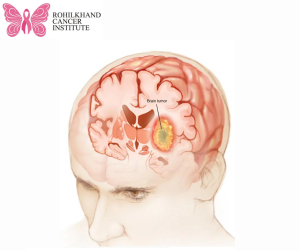
Brain tumours can range in size from little to enormous. Certain brain tumours are discovered at relatively tiny sizes because they immediately generate symptoms. Some brain tumours enlarge greatly before they are discovered. The brain is divided into regions that are more and less active. A brain tumour may not manifest symptoms immediately if it originates in a less active area of the brain. Before the tumour is discovered, the size of the brain tumour may increase significantly.
The kind, location, and size of your brain tumour will all affect your treatment options. Radiation therapy and surgery are common therapies.
Types
Brain tumours can take many different forms. The sort of cells that comprise the tumour determines the type of brain tumour. Specific laboratory studies on the tumour cells can provide cell-specific information. This information is used by your healthcare team to determine the sort of brain tumour you have.
Typically, certain kinds of brain tumours are not malignant. These are known as benign or noncancerous brain tumours. Usually, certain kinds of brain tumours are malignant. These are referred to as malignant brain tumours or brain cancers. There are two types of brain tumours: benign and malignant.
Brain tumours classified as benign usually grow slowly. Brain tumours that are malignant typically grow quickly.
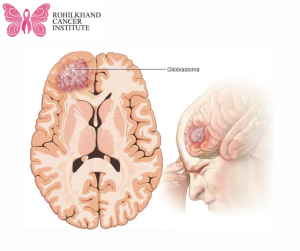
Glioblastoma
One type of cancer known as glioblastoma begins in the astrocytes, which are cells that nourish nerve cells. It may develop in the spinal cord or brain.

Medulloblastoma
One kind of brain cancer that begins in the cerebellum is termed medulloblastoma. The most prevalent kind of malignant brain tumour in children is called medulloblastoma.
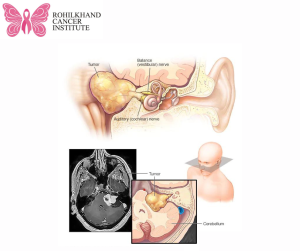
Acoustic neuroma (vestibular schwannoma)
A benign tumour called an acoustic neuroma (vestibular schwannoma) arises on the balance and hearing nerves that connect the brain to the inner ear. The vestibulocochlear nerve, the eighth cranial nerve, is formed by the twining of several nerves together. Hearing loss and unbalance may result from the tumor’s pressure on the nerve.
Brain tumour types consist of:
Gliomas and related brain tumors. Cell growths that resemble glial cells are known as gliomas. In the brain tissue, glial cells encircle and support nerve cells. Astrocytomas, glioblastomas, oligodendrogliomas, and ependymomas are among the several forms of gliomas and associated brain tumours. Although they can be benign, most gliomas are malignant. The most prevalent kind of malignant brain tumour is glioblastoma.
Choroid plexus tumors. The cells that produce the fluid enveloping the brain and spinal cord are the source of choroid plexus tumours. The term cerebrospinal fluid refers to this fluid. The fluid-filled spaces in the brain known as the ventricles are home to choroid plexus tumours. Benign or malignant choroid plexus tumours are both possible. This kind of brain tumor’s malignant form is called choroid plexus carcinoma. It affects kids more frequently.
Embryonal tumors. Cells leftover during foetal development give rise to embryonal tumours. The cells, known as embryonal cells, remain in the brain beyond birth. Malignant brain tumours called embryonal tumours are most common in infants and early childhoods. Medulloblastoma is the most typical kind of embryonal tumour. Usually found in the cerebellum, a region of the brain in the lower back.
Germ cell tumors. The germ cells that develop into the sperm and egg cells are the precursors of germ cell tumours. The testicles and ovaries contain the majority of germ cells. However, they can occasionally be found in other body parts, such as the brain. Brain germ cell tumours are frequently found in close proximity to the pituitary or pineal glands. Most germ cell tumours are not harmful. Children are more likely to have them.
Pineal tumors.Pineal tumours originate in and around the pineal gland in the brain. The brain’s centre is home to the pineal gland. It produces the hormone melatonin, which promotes restful sleep. Pineal tumours may be cancerous or benign. The most frequent form of malignant pineal tumour in children is called pineoblastoma.
Meningiomas.Tumours of the brain that begin in the membranes surrounding the brain and spinal cord are called meningiomas. Though they are typically benign, meningiomas can occasionally be cancerous. Benign brain tumours most commonly occur as meningiomas.
Nerve tumors. Growths within and surrounding nerves are known as nerve tumours. Acoustic neuroma, also known as schwannoma, is the most prevalent form that occurs in the head. On the major nerve that joins the brain and inner ear, there is a benign tumour.
Pituitary tumors.Pituitary tumours can start in the area surrounding the gland. This little gland can be found close to the brain’s base. The majority of tumours that develop in or near the pituitary gland are benign. The pituitary gland itself is the site of pituitary tumours. One kind of brain tumour that develops close to the pituitary gland is called a craniopharyngioma.
Other brain tumors.Rare tumours of many other kinds can occur in and around the brain. Muscles, blood arteries, and connective tissue around the brain can all become the site of a tumour. The skull’s bones are prone to tumour formation. The immune system cells in the brain that fight germs can give rise to malignant brain tumours. We refer to this particular form of brain cancer as primary central nervous system lymphoma.
Symptoms
The signs and symptoms of a brain tumor depend on the brain tumor’s size and location. Symptoms also might depend on how fast the brain tumor is growing, which is also called the tumor grade.
The following are some common indications and symptoms of brain tumours:
(1) Hearing problems.
(2) Speech problems.
(3)Memory problems.
(4) Feeling very tired.
(5) Nausea or vomiting.
(6) Trouble with balance.
(7) Confusion in everyday matters.
(8) Personality or behavior changes.
(9) Feeling very hungry and gaining weight.
(10) Having trouble following simple commands.
(11) Losing feeling or movement in an arm or a leg.
(12) Seizures, especially if there is no history of seizures.
(13) Headaches that happen more often and seem more severe.
(14) Headache or pressure in the head that is worse in the morning.
(15) Dizziness or a sense that the world is spinning, also called vertigo.
(16) Headaches that are sometimes described as tension headaches or migraines.
(17) Eye problems, such as blurry vision, seeing double or losing sight on the sides of your vision.
The symptoms of non-cancerous brain tumours usually appear gradually. Benign brain tumours are another name for noncancerous brain tumours. They may produce mild symptoms that take some time to manifest. Over the course of months or years, the symptoms may worsen.
The symptoms of cancerous brain tumours worsen rapidly. Malignant or brain malignancies are other names for cancerous brain tumours. They produce symptoms that appear out of the blue. In a couple of days or weeks, they worsen.
Brain tumor headaches
The most typical sign of a brain tumour is headaches. Of those with brain tumours, around half get headaches. When a brain tumour grows and presses on nearby healthy cells, headaches may result. Alternatively, a brain tumour may result in cerebral oedema, which raises head pressure and produces a headache.
Brain tumor-related headache discomfort is frequently severe in the morning. But it might occur at any moment. Some people experience headaches that keep them up at night. Headaches from brain tumours can hurt worse when you cough or strain. The most common complaint from patients with brain tumours is that they have a tension-like headache. Some claim that the headache has a migraine-like sensation.
Back of the head brain tumours may produce headaches accompanied by neck pain. A headache may feel like sinus or eye pain if the brain tumour is located in the front of the head.
Brain tumor symptoms by location
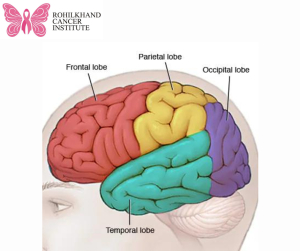
Brain lobes
There are four lobes on each side of your brain. Control over voluntary movement or activity and cognitive processes are both mediated by the frontal lobe. The occipital lobe is mostly in charge of vision, whereas the parietal lobe handles information about movement, taste, warmth, and touch. Memories are processed by the temporal lobe, which also integrates taste, hearing, sight, and touch perceptions.
The cerebrum is the primary region of the brain. Symptoms of brain tumours in various areas of the cerebrum may vary.
Brain tumors in the front of the brain.The front of the brain contains the frontal lobes. They have command over thought and motion. Brain tumours in the frontal lobes may cause difficulty walking and with balance. Personality changes, including forgetfulness and disinterest in routine activities, may occur. Family members may observe that their loved one appears to be different when they have a brain tumour.
Brain tumors in the middle of the brain.The brain’s upper middle region contains the parietal lobes. They aid in the processing of sensory data related to taste, smell, vision, and hearing. Brain tumours in the parietal lobe can lead to sensory issues. Problems with hearing and vision are two examples.
Brain tumors in the back of the brain. In the rear of the brain are the occipital lobes. They have vision control. Brain tumours in the occipital lobe can result in blindness.
Brain tumors in the lower part of the brain. The brain’s sides contain the temporal lobes. They interpret sensory data and memories. Memory issues may arise from brain tumours in the temporal lobe. They could give someone the impression that something is tasted, smelt, or seen that isn’t. Occasionally, the flavour or aroma is disagreeable or peculiar.
When to see a doctor
Schedule a visit with your physician if you are concerned about any persistent symptoms.
Causes
Brain tumors that begin in the brain
Primary brain tumours are brain tumours that originate as brain cell proliferation. They may originate in the brain itself or in adjacent tissue. Meninges, the membranes covering the brain, may be among the nearby tissue. Additionally, brain tumours can develop in the pituitary, pineal, and nerves.
DNA alterations in brain or nearby cell populations result in brain tumours. The instructions that inform a cell what to do are encoded in its DNA. The alterations instruct the cells to proliferate rapidly and survive when healthy cells would normally perish as a part of their normal life cycle. This produces a large number of additional brain cells. The cells may develop into a development known as a tumour.
The exact source of the DNA alterations that result in brain tumours is unknown. The cause of brain tumours in many cases remains unknown. Children can inherit genetic mutations from their parents. The modifications may raise one’s chance of developing a brain tumour. Rare are these inherited brain tumours. See your healthcare practitioner if there is a family history of brain tumours. If you’re wondering if a brain tumour runs in your family, you might want to consult with a physician who specialises in genetics.
Primary brain tumours are most often the case when brain tumours affect children. Adult brain tumours are more frequently caused by cancer that metastasised to the brain from another location.
Cancer that spreads to the brain
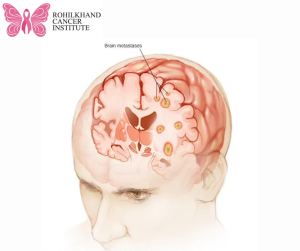
Brain metastases
Brain metastases happen when cancer begins elsewhere in the body and spreads (metastasizes) to the brain.
Cancer that begins outside the brain and progresses there might result in secondary brain tumours. Metastatic cancer is the term for cancer that spreads.
Although any cancer can travel to the brain, the following are prevalent types:
(1) Melanoma.
(2) Lung cancer.
(3) Colon cancer.
(4) Breast cancer.
(5) Kidney cancer.
Why some cancers are more prone to spread to other locations than others and why some only spread to the brain is unknown.
Those with a prior history of cancer are most likely to develop secondary brain tumours. In rare cases, a brain tumour could be the initial indication of cancer that started in another part of the body.
Compared to primary brain tumours, secondary brain tumours are significantly more common in adults.
Risk factors
The cause of primary brain tumours is unknown in the majority of cases. Doctors have, however, discovered a few variables that could increase the risk.
Among the risk factors are:
Age.Although they can occur at any age, brain tumours primarily affect elderly persons. Adults are the main target of some brain tumours. The majority of brain tumours occur in youngsters.
Race.The brain tumour can strike anyone. However, certain racial groups are more likely to experience specific forms of brain tumours. Gliomas, for instance, are more prevalent in Caucasians. Black persons are more likely to have meningiomas.
Exposure to radiation.Brain tumour risk is higher in those who have been exposed to high doses of radiation. Ionising radiation is the term for this intense radiation. The radiation is potent enough to alter the body’s cells’ DNA. Tumours and malignancies may result from the DNA alterations. Ionising radiation is produced by atomic bomb radiation exposure and radiation treatment used to cure cancer.
Brain tumours and low-level radiation from commonplace items are unrelated. Radio waves and mobile energy are sources of low quantities of radiation. There is insufficient proof to support the theory that mobile use causes brain tumours. However, additional research is being done to ensure
Inherited syndromes that increase the risk of brain tumor.Brain tumour risk is increased by certain genetic variations that run in families. The genetic alterations responsible for neurofibromatosis 1 and 2, tuberous sclerosis, Von Hippel-Lindau disease, Lynch syndrome, Li-Fraumeni syndrome, familial adenomatous polyposis, Cowden syndrome, and Gorlin syndrome are a few examples.
Prevention
It is not possible to avoid brain tumours. You did not do anything to cause a brain tumour to develop in yourself.
People who are more likely to develop a brain tumour may want to think about getting tested. Brain tumours cannot be prevented by screening. However, brain tumours are more likely to be successfully treated when discovered early on, which is why screening may be helpful.
Discuss with your healthcare practitioner any family history of brain tumours or genetic diseases that raise the risk of brain tumours. You may want to consult with a genetic counsellor or other medical professional with training in genetics. This person can assist you in managing your risk and understanding it. You may think about screening testing for brain tumours, for instance. To assess your eyesight, hearing, balance, coordination, reflexes, and vision, a neurological exam or imaging test may be used.
Related Posts

कीमोथेरेपी क्या है? प्रक्रिया, फायदे और सावधानियाँ
-
Posted by
 admin
admin
Advanced Cancer Treatment at Rohilkhand Cancer Institute – Top Oncology Hospital in Bareilly
-
Posted by
admin

Immune-Based Cancer Treatments in Bareilly at Rohilkhand Cancer Institute
-
Posted by
admin

Why Rohilkhand Cancer Institute is the Best Choice for Childhood Cancer Treatment in Bareilly
-
Posted by
admin
Why Rohilkhand Cancer Institute is the Best Choice for Interventional Radiology in Bareilly
-
Posted by
admin
Brain Tumor Surgery in Bareilly at Rohilkhand Cancer Institute – Advanced & Expert Care
-
Posted by
admin

आयुष्मान भारत योजना के तहत Rohilkhand Cancer Institute में सस्ता कैंसर इलाज
-
Posted by
admin
Advanced PET Scan Services at Rohilkhand Cancer Institute, Bareilly
-
Posted by
admin
Best Hospital for Stomach Cancer Treatment in Bareilly – Rohilkhand Cancer Institute, Bareilly
-
Posted by
admin

Top Pediatric Oncology Experts in Bareilly: Care & Compassion at Rohilkhand Cancer Institute
-
Posted by
admin

Expert Bone Cancer Specialists in Bareilly: Treatment at Rohilkhand Cancer Institute
-
Posted by
admin

A New Era in Cancer Treatment: Immunotherapy Services at Rohilkhand Cancer Institute
-
Posted by
admin